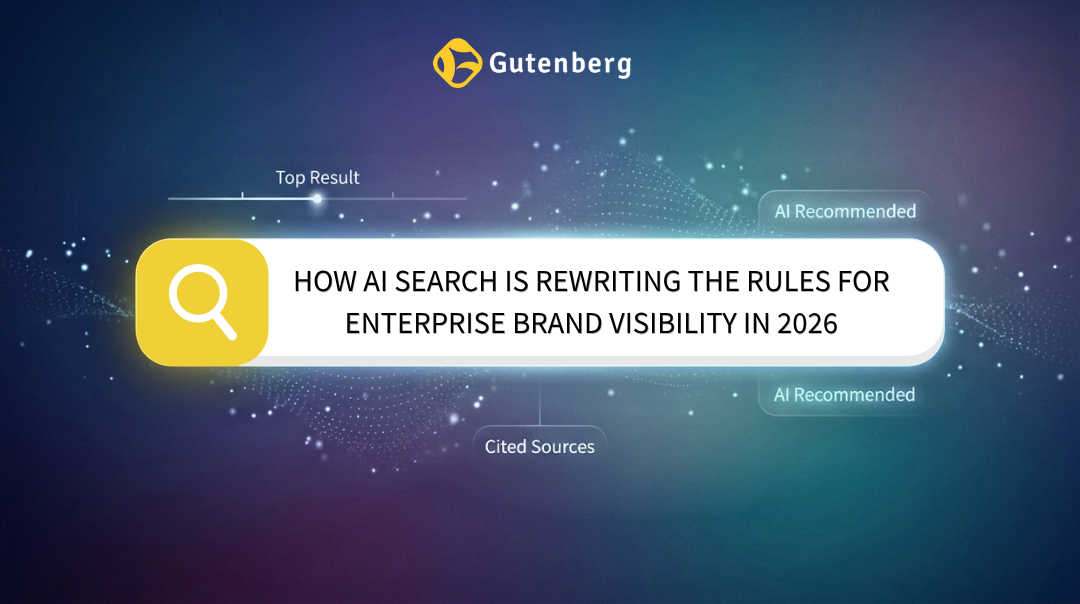
If you ran a search for your brand today and a competitor showed up in the AI-generated answer instead, that’s not a glitch. That’s the new reality of AI search in 2026.
Search engines are no longer just matching keywords to pages. They’re synthesizing answers from across the web, pulling from sources they trust, and presenting those answers without users ever clicking through to a website. For enterprise teams that spent years optimizing for the top 10 results, this is a real problem.
Enterprise brand visibility now depends on something fundamentally different: whether AI systems recognize your brand as a credible, citable source. This blog breaks down what that shift looks like, and what a practical AI search optimization strategy looks like for large marketing organizations in 2026.
What Is AI Search Optimization?
AI search optimization is the process of making your brand visible and citable within AI-generated answers across platforms like ChatGPT, Google AI Overviews, and Perplexity.
Unlike traditional SEO, which focuses on ranking pages, AI search optimization focuses on:
- Structuring content for direct answers
- Building authority that AI systems trust
- Ensuring your brand is referenced in synthesized responses
In a world of zero-click search, visibility is no longer about traffic alone. It’s about being the source AI models rely on.
What AI Search Actually Changes for Enterprise Brands
The way people search has changed. And the way brands need to show up has changed with it.
From keywords to context
Traditional search worked on a simple principle: match the user’s words to a page. AI search algorithms work differently. They try to understand what the user actually means, then pull together the most relevant answer from multiple sources. That’s a big shift for how brands need to structure content.
- It’s not enough to have a page that ranks for a keyword. Your content needs to be the best answer to a specific question.
- AI models are looking for clarity, authority, and structure. Vague, general content doesn’t get cited.
- Entity-based SEO is becoming more important than traditional keyword density. Search systems are learning to associate brands with specific topics, not just specific words.
Conversational search is now the default
Users are asking full questions instead of typing fragments. “What’s the best AI marketing platform for mid-size B2B companies” is the kind of search query that AI systems are built to answer. Your content needs to match that style.
- Write for questions, not just keywords.
- Think about what your ideal buyer would literally say out loud, and build content around that.
- Structure content with clear answers near the top, then supporting detail below.
The zero-click problem
In a zero-click search environment, users get the answer they need without visiting any website. That means your traditional traffic metrics can drop even as your brand visibility rises. It also means that if you’re not being cited by AI, you’re essentially invisible.
Understanding AI search behavior is now a core part of any enterprise marketing strategy. The brands that are winning are the ones that have figured out how to be the source AI models reach for first.
AEO and GEO: The New Foundations of AI Search Optimization
Two terms are showing up in every serious search strategy conversation right now: Answer Engine Optimization (AEO) and Generative Engine Optimization (GEO). Here’s how to think about them.
Answer Engine Optimization (AEO)
AEO is about making your content easy for AI systems to find, read, and use as a direct answer. Think of it as the tactical layer of your AI search optimization strategy.
What AEO focuses on:
- Structured content formats (FAQ sections, how-to guides, definition pages)
- Schema markup that helps AI models understand what your content is about
- Short, direct answers near the top of each page
- Clear headings that match the way questions are phrased
If you want to go deeper on how AEO works in practice for tech brands, this guide on Answer Engine Optimization (AEO) is worth a read.
Generative Engine Optimization (GEO)
GEO is the strategic layer. It’s about building your brand’s authority within the AI-powered search ecosystem so that AI systems consistently recognize you as a trusted source.
What GEO focuses on:
- Building citation signals across high-authority third-party sites
- Strengthening your brand’s presence in knowledge graphs and structured databases
- Creating deep, comprehensive content that demonstrates real expertise
- Maintaining consistency in how your brand is described and referenced across the web
AEO vs. GEO: How they work together
AEO gets you cited in specific answer moments. GEO builds the long-term authority that makes those citations happen consistently. Enterprise brands need both. Neither one works as well without the other.
Building an AI Search Optimization Strategy at Enterprise Scale
Most enterprise marketing teams didn’t build their content strategy for AI-first discovery. That’s okay. But it does mean some foundational work is needed before optimization can really take hold.
Step 1: Audit your current AI search visibility
Before you optimize, you need to know where you stand. Run your top 20 brand-defining queries through ChatGPT, Perplexity, Google AI Overviews, and any other AI search tools your buyers are likely using.
- Is your brand being cited at all?
- If yes, is the information accurate and complete?
- Which competitors are showing up in your place?
- What questions are returning answers where your brand should be present but isn’t?
This audit gives you a real baseline for measuring progress as you implement your strategy.
Step 2: Rethink your content architecture
Content built for AI-first discovery looks different from content built for traditional SEO. Here’s what matters most:
- Answer-first structure: Lead with the direct answer, then expand with context and detail.
- Clear topical clusters: AI models associate brands with specific topic areas. Build deep content around the topics you want to own.
- Consistent terminology: Use the same language to describe your products, services, and expertise everywhere. Inconsistency confuses AI systems.
- Content freshness: Regularly updated content signals that your brand is an active authority in the space.
Step 3: Build entity authority
Entity-based SEO is about making sure AI systems can confidently identify your brand as an authority on specific topics. This goes beyond on-site content.
- Get your brand accurately represented in Wikipedia and industry knowledge bases
- Optimize your Google Knowledge Panel
- Earn mentions and citations on authoritative third-party sites in your industry
- Keep your brand information consistent across all platforms
Step 4: Redefine how you measure success
In a zero-click search world, organic click-through rate is only part of the story. Enterprise teams need new metrics:
- AI citation share: How often does your brand appear in AI-generated answers for your key topics?
- Brand mention share: How frequently is your brand referenced across AI search results vs. competitors?
- Answer presence rate: On which of your top queries does your brand appear as the cited source?
For a broader view of what these shifts mean for enterprise strategy, the latest thinking on AI marketing trends 2026 is a useful reference point.
The Gutenberg Moment: AI Search Is a Publishing Revolution
AI search is redistributing authority in the same way the printing press once did.
Before, brands controlled visibility through media spend and rankings.
Now, AI controls visibility through citation and trust.
This means:
- Depth matters more than volume
- Authority matters more than optimization
- Being useful matters more than being visible
The brands that understand this will lead.
How Gutenberg Helps Enterprise Brands Win in AI Search
Gutenberg works with enterprise teams to build AI search optimization strategies that deliver real visibility.
This includes:
- AI-native content architecture built for AEO and GEO
- Entity authority building across platforms
- AI citation tracking and optimization
- Human-led AI strategy for scalable execution
The authority redistribution risk
Brands that don’t invest in AI search optimization right now risk watching decades of earned brand authority quietly transfer to competitors who built their content strategy for the AI-powered search ecosystem. This isn’t hypothetical. It’s already happening.
How Gutenberg helps enterprise brands win in AI search
At Gutenberg, we work specifically with enterprise marketing teams to build the content infrastructure that drives AI-driven search visibility. Here’s what that looks like in practice:
- AI-native content strategy: We build content architectures designed from the ground up for AEO and GEO, not retrofitted from old SEO playbooks.
- Entity authority building: We help brands establish and strengthen their presence in the knowledge systems AI models draw from.
- AI citation auditing and tracking: We monitor how and where your brand appears in AI search results, and build programs to improve that presence over time.
- Human-led AI strategy: Our approach pairs AI-powered efficiency with human editorial judgment. We don’t just run tools. We build strategies.
If you want to see what a human-led approach to AI marketing looks like at scale, take a look at our Human-led AI marketing strategy service page.
Conclusion
Search has changed. Visibility has changed. Authority has changed.
AI search optimization is no longer optional for enterprise brands. It is the foundation of how your brand will be discovered, trusted, and chosen.
The brands that win in 2026 will not be the ones that rank highest.
They will be the ones AI systems trust the most.
FAQs
1. What is AI search optimization, and how is it different from traditional SEO?
AI search optimization is the practice of making your brand and content visible and citable within AI-generated search answers. Traditional SEO focused on ranking pages for keyword queries. AI search optimization is about being recognized by AI systems as an authoritative, trustworthy source on a specific topic, so your brand gets cited in the synthesized answers those systems produce.
2. What is the difference between AEO and GEO?
Answer Engine Optimization (AEO) focuses on structuring individual pieces of content so AI can easily extract and use them as direct answers. Generative Engine Optimization (GEO) is the broader strategy of building your brand’s authority and credibility across the AI-powered search ecosystem so it consistently earns citations over time.
3. How do I know if my brand is showing up in AI search results?
The simplest starting point is manual testing. Run your most important brand and category queries through ChatGPT, Perplexity, and Google AI Overviews. Note whether your brand appears, what context it appears in, and whether the information is accurate. For ongoing monitoring, a number of enterprise SEO platforms are now building AI citation tracking into their tools.
5. How long does it take to see results from an AI search optimization strategy?
Some tactical changes, like adding structured data or restructuring content for answer-first formats, can start showing impact within a few weeks. Broader authority-building efforts, like building citation signals and strengthening entity presence, typically take 3 to 6 months to show meaningful movement. Consistent effort over 6 to 12 months is where enterprise brands see compounding gains in AI-driven search visibility.