AI did not enter marketing as a marginal improvement. It arrived as a structural force that changed how work moves through teams, how decisions are made, and how value is delivered to the business.
Over the past few years, organizations adopted AI to accelerate research, content, targeting, and analysis. What followed was not just speed, but exposure. Weak planning became visible. Fragmented ownership surfaced quickly. Outdated operating models struggled to keep pace.
As we move into 2026, the conversation has matured. The focus is no longer on tools or experimentation. The real impact of AI in Marketing Trends 2026 is about how AI reshapes operating models, accountability, and decision-making at scale.
The trends outlined below are not speculative forecasts. They are patterns already emerging inside high-performing organizations and will define how AI in marketing 2026 functions across strategy, execution, and measurement.
Trend #1 – Pods Replace Linear Marketing Execution
AI dramatically compresses the distance between insight and action. Performance signals surface continuously, not at the end of campaigns. Creative iterations happen faster, and optimization is expected while work is still live.
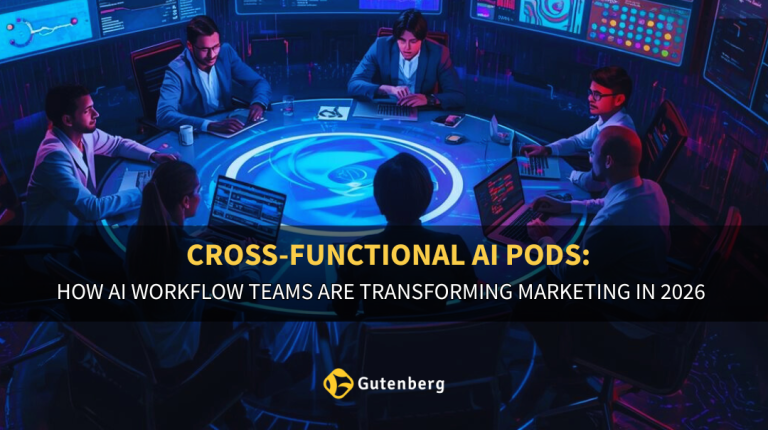
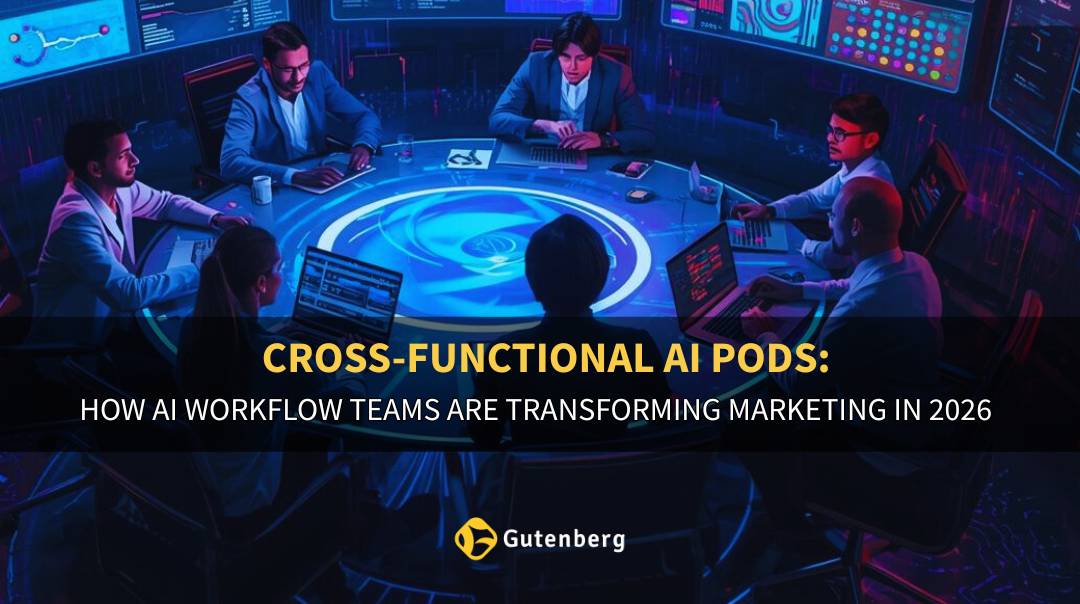
By 2026, pod-based execution models are becoming the default response. These models bring strategy, creative, analytics, and technical execution into one unit, reducing friction and enabling teams to act on AI insights immediately.
- Strategy and execution operate in parallel rather than sequence
- Insights move directly into action without repeated handoffs
- Campaigns evolve during delivery instead of post-campaign review
- Accountability improves because ownership sits within the pod
Trend #2 – Strategy Moves Upstream Through Predictive Planning
Marketing strategy has historically been shaped by hindsight. AI changes that dynamic.
In 2026, teams increasingly model outcomes before campaigns launch, shifting strategy upstream and reducing dependency on retrospective reporting.
- Campaign scenarios are modeled before committing spend
- Channel and audience decisions reflect forecasted impact
- Risk, saturation, and diminishing returns are identified early
- Strategy reviews become forward-looking
A 2024 BCG report shows that AI leaders integrating AI into core functions achieved stronger revenue growth, reinforcing why predictive planning defines the future of AI in marketing.
Trend #3 – AI Fluency Becomes a Core Marketing Skill
By 2026, access to AI tools will be universal. What will differentiate performance is not access, but capability.
Teams that understand how AI systems reason, fail, and scale will outperform those that treat AI as a black box.
- Marketers actively guide and validate AI output
- Creative leaders focus on direction rather than manual production
- Quality depends on human oversight, not model sophistication
- Teams move faster without sacrificing coherence
Trend #4 – GEO Redefines How Visibility Is Earned
Discovery behavior is changing. Buyers increasingly rely on AI-generated summaries, assistants, and recommendations to understand markets before engaging with brands.
As a result, content must be written to be understood by AI systems, not just ranked.
- Content is structured for AI interpretation and reuse
- Depth outweighs publishing frequency
- Authority is built through consistency, not keywords
- Writing focuses on explanation and meaning
Trend #5 – Personalization Becomes Intent-Led, Not Volume-Led
Personalization fatigue is not caused by irrelevance, but by excess. AI makes it easy to personalize everything.
In 2026, the real advantage lies in knowing when not to.
- Messaging adapts to buying intent rather than static segments
- Behavioral signals determine timing and relevance
- First-party data becomes the primary input
- Engagement supports journey progression
Trend #6 – AI Expands Creative Capacity Without Replacing Creativity
The fear that AI would replace creativity misunderstood the constraint. The issue was never ideas. It was time, scale, and operational friction.
AI removes that friction.
- Teams explore multiple concepts early
- Ideas are tested before heavy production
- Repetitive execution is automated
- Senior creatives focus on judgment and narrative
Trend #7 – Privacy and Trust Become Structural Requirements
As AI influences targeting and personalization, scrutiny around data usage intensifies.
In 2026, privacy failures do more than create compliance risk. They slow adoption and damage trust.
- First-party data strategies take priority
- Consent and transparency are embedded by design
- Sensitive decisions require human oversight
- Governance is built into workflows
Trend #8 – Measurement Evolves to Match AI Speed
Marketing execution has outpaced measurement for years.
In 2026, AI reshapes measurement itself, closing the gap between activity and business impact.
- Attribution models adapt dynamically
- Early signs of diminishing returns surface sooner
- Long-term revenue and brand impact are modeled
- Insights guide decisions, not just reporting
Trend #9 – AI Consolidates Into Marketing Operating Systems
Early AI adoption focused on tools. Over time, tool sprawl created fragmentation rather than advantage.
By 2026, consolidation becomes inevitable.
- Fewer tools with deeper integration
- Shared data and context across teams
- Clear ownership across workflows
- AI treated as infrastructure
Trend #10 – Visual Creation Shifts From Shoots to Systems
Visual production has traditionally been slow and expensive. In 2026, AI turns image creation into a scalable system rather than a one-time event.
Images are generated, adapted, and tested continuously across markets.
How visual AI reshapes production
- High-quality visuals without physical shoots
- Models, poses, and environments adapt instantly
- Assets localize at scale
- Continuous testing replaces static production
This evolution is central to AI content creation 2026 at enterprise scale.
How Gutenberg Approaches AI in Marketing
At Gutenberg, AI is treated as an operating system, not a shortcut.
The focus is on structured workflows where AI accelerates execution while humans retain judgment, accountability, and strategic control.
Gutenberg’s Human-Led AI model:
- Strategy remains human-led
- AI embedded across pod-based workflows
- Strong governance for generative systems
- Clear linkage between AI output and business outcomes
This approach aligns directly with the realities of AI in Marketing Trends 2026.
Conclusion: Key Takeaways for Marketing Leaders
AI in Marketing Trends 2026 are driven by structure and operating models, not by new tools or surface-level innovation.
As execution speeds up, weak workflows and unclear ownership become impossible to hide.
Predictive planning is replacing reactive optimization, allowing teams to make smarter decisions before spend is committed.
AI fluency is now a core marketing capability, with human judgment playing a critical role in guiding AI output.
Intent-led personalization and clearer content understanding outperform high-volume, algorithm-driven tactics.
Creative scale improves when friction is removed, while trust, privacy, and governance remain foundational.
Human-Led AI is how speed, quality, and accountability scale together.
Frequently Asked Questions
1. What are the most important AI in Marketing Trends 2026 to watch?
The most important AI in Marketing Trends 2026 focus on operating models rather than tools. Key shifts include pod-based execution, predictive strategy planning, intent-led personalization, AI-driven measurement, and system-based creative production. These trends show that AI is changing how marketing teams work, not just how fast they execute.
2. How will AI change marketing strategy in 2026?
In 2026, AI moves marketing strategy upstream. Instead of reacting to past performance, teams use AI to model outcomes before campaigns launch. This allows better budget allocation, early risk detection, and clearer links between strategy and business impact.
3. What does human-led AI marketing actually look like in practice?
Human-led AI marketing means AI supports speed, scale, and analysis, while humans retain judgment, direction, and accountability. Agencies like Gutenberg apply AI across research, content, media, and measurement, while keeping strategy, creativity, and governance firmly human-led.
4. How is AI improving personalization without overwhelming audiences?
Modern AI personalization trends focus on intent and timing rather than volume. AI evaluates behavioral signals to determine when messaging will be useful, not just possible. This reduces fatigue and increases relevance.
5. Why are pod-based teams becoming common in AI-driven marketing?
AI accelerates feedback loops, making traditional silos inefficient. Pod-based teams bring strategy, creative, analytics, and execution together so AI insights can be acted on immediately.
6. How does AI change content creation and visual production in 2026?
In AI content creation 2026, content and visuals are no longer produced as one-off assets. AI enables continuous generation, adaptation, and testing across regions and audiences, while humans maintain consistency and quality.
7. What role do agencies like Gutenberg play in AI-driven marketing transformation?
Agencies like Gutenberg help organizations move from tool-based AI adoption to system-level transformation. This includes redesigning workflows, embedding governance, and aligning AI with business outcomes.