Most marketing teams in 2026 have adopted some form of AI. They have the tools. They have the subscriptions, writing tools, content creation platforms and a lot more resources. But here is the thing: having AI tools and actually running an AI-powered marketing operation are two very different things.
The teams that are pulling ahead right now are not just using more tools. They are using a different way of working altogether. They have reorganized into what are called cross-functional AI pods, which are small, focused groups where everyone works toward the same outcome, with AI woven into every step of the process. These AI workflow teams are not a theory or a pilot program anymore. They are becoming the standard for high-performance marketing in 2026.
If you are a marketing director, VP, or CMO evaluating how to get more out of your team and your AI investments, this post is for you. We are going to break down what these pods are, how they work day to day, why they outperform traditional teams, and exactly how to build one.
Why Traditional Marketing Structures Are Holding Teams Back
Siloed Team Organization
- Separate content, paid media, SEO, and analytics teams
- Each team works in its own lane with its own priorities
Slow, Sequential Workflows
- Work is handed off like a relay race (e.g., blog post moves from writer to SEO to design to approval to social)
- Publishing takes a week or two
Fragmented Output and Slow Feedback
- AI tools are used individually, not collaboratively
- Output remains fragmented
- Feedback loop is slow because teams are not working together in real time
The Real Bottleneck: Structure, Not Tools
- Adding AI tools to old workflows does not solve the problem
- High-performing teams fix the structure first, not just the tools
- Structural change is the key differentiator for agile, high-performing teams
What Cross-Functional AI Pods and AI Workflow Teams Actually Are
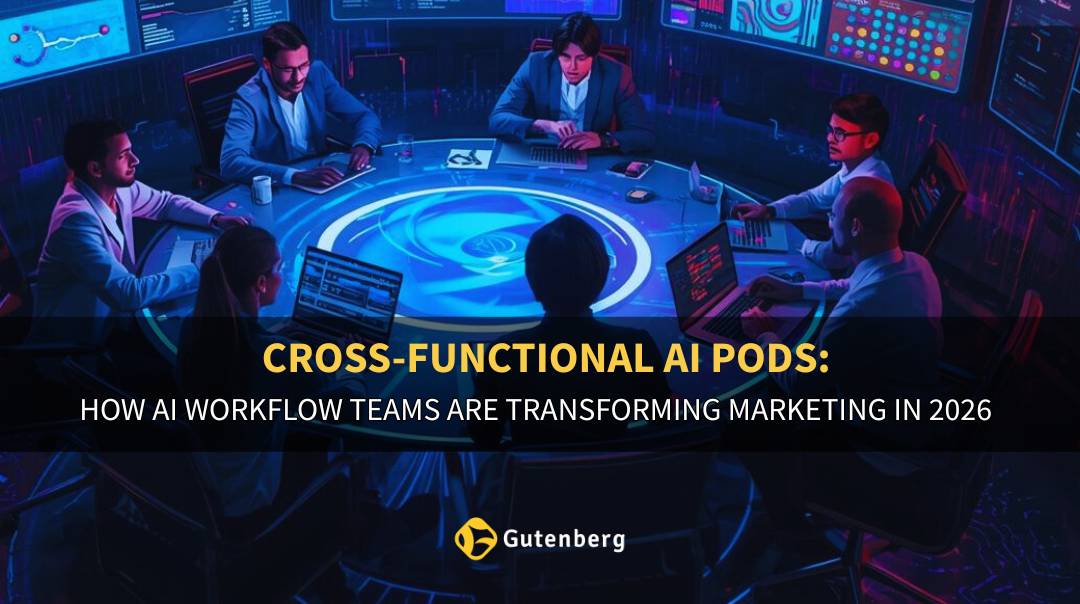
A cross-functional AI pod is a small, self-contained team, usually four to six people, built around a specific marketing outcome rather than a marketing function. Instead of organizing by skill set, you organize by goal.
Think of it this way. Instead of having a content team, a paid team, and a data team all working separately on a campaign to drive demo requests, you have one pod that owns the entire initiative from brief to conversion. That pod has everything it needs inside it: strategy, content, data, and AI operations.
What Does a Typical Cross-Functional AI Pod Look Like?
- Campaign Lead or Strategist: Owns the brief, sets the goal, and makes key decisions on creative direction and priorities.
- AI Operator: Manages AI workflows, selects and structures prompts, quality-checks outputs, and builds reusable prompt libraries to increase pod efficiency.
- Content Specialist: Refines AI-generated content, ensuring it aligns with brand voice, corrects errors, adds depth, and maintains a human touch.
- Data or Analytics Person: Monitors performance, provides real-time insights, and helps the team make smarter, data-driven decisions week over week.
Depending on the pod’s focus, you might also have a designer or a paid media specialist. But the key point is that everyone is in the same room, or virtual room, working toward the same number.
This is a fundamentally different model from the agile teams that software engineering adopted years ago. Those teams organize around sprints and velocity. AI pods organize around outcomes. The question is not “what did we ship this sprint?” It is “did we move the number we were supposed to move?”
This approach to human-AI collaboration in marketing is what separates teams that are genuinely getting results from teams that are just busy.
Cross-Functional AI Pods vs. Legacy Marketing Structures
Let’s put the two models side by side so you can see exactly where the gap is.
| Dimension | Traditional Siloed TeamMarketing Team | Cross-Functional AI Pod (AI Workflow Team) |
|---|---|---|
| Time from brief to publish | 7 to 14 days | 2 to 4 days |
| Feedback loop | End of campaign or monthly | Weekly, sometimes real-time |
| AI usage | Individual tool adoption | Team-level workflow integration |
| Accountability | Department-level | Outcome-level |
| Scalability | Requires more headcount | Replicate the pod model |
| Institutional knowledge | Stored in individual people | Documented in shared prompt libraries |
For example, a B2B software company reorganized their demand generation function into two AI pods. One pod focused on mid-funnel nurture content. The other focused on bottom-funnel conversion assets. Within one quarter, they cut their content production time in half, increased their content volume by three times, and improved their demo request rate by 34%. They did not add a single headcount. They just changed the structure.
It is also worth being clear about something: this is not about replacing marketers with AI. The pod model actually demands more from marketers, not less. It requires strategic thinking, editorial judgment, data literacy, and the ability to move fast. What it removes is the waste: the unnecessary meetings, the slow handoffs, the approval chains that add days without adding value.
Good pod-based ops keep humans at the center of decision-making while using AI to handle the production load. This kind of AI team structure is built on the principle that people should spend their time on the work that actually requires human judgment.
How to Build AI-First Marketing Teams Using Cross-Functional AI Pods
How to build AI-first marketing teams:
Start by creating cross-functional AI pods that combine strategy, content, AI operations, and analytics inside a single outcome-focused team. Assign clear KPIs, build shared prompt libraries, and run weekly performance reviews to continuously improve results.
This is the part most people want to skip to, so here it is. Learning how to build AI-first marketing teams does not require a complete org redesign overnight. You can start with one pod and expand from there.
Step 1: Audit Your Current Team for Pod Readiness
Look at your existing roles and map them to the pod archetypes above. Most teams will find they have the content and strategy roles covered, but they are missing the AI operator. That is the critical gap. You also want to look at your current toolstack and ask whether your tools are set up for team-level use or just individual use.
Step 2: Define Your First Pod’s Mandate
Do not try to restructure everything at once. Pick one specific outcome: increase demo requests from organic content by 25% in Q2, or improve email open rates for the mid-funnel sequence by 15%. Assign a pod to own that outcome completely.
Step 3: Build the Prompt and Process Library
Before the pod starts producing, spend one week documenting. Write down the brand voice rules. Create templates for briefs. Build a starting set of prompts for the most common content types. This library is what will make the pod faster every single week instead of starting from scratch every time.
Step 4: Set the Operating Cadence
Use the weekly rhythm described above. The cadence is what keeps the pod aligned without the constant meetings that slow traditional agile teams down. If you are running two or more pods, set up a biweekly sync between pod leads to share what is working across the organization.
Step 5: Shift Your KPIs to the Pod Level
This is the cultural change that makes or breaks the model. If you are still measuring individual productivity, you are incentivizing the wrong behavior. Shift to pod-level outcome metrics: pipeline influenced, conversion rate from content, revenue attributed to the pod’s campaigns. This is also where working with a specialized AI digital marketing agency can help, because they have already built these measurement frameworks and can help you avoid common mistakes during the transition.
Step 6: Replicate and Scale
Once Pod 1 has a working playbook and a documented process library, starting Pod 2 is dramatically easier. You are not building from scratch. You are running a proven model with a new mandate and a new target outcome. This is how high-performing organizations build out their collaboration models over time, one well-run pod at a time.
How Gutenberg Can Help You Make the Shift
Building cross-functional AI pods sounds straightforward on paper, but making it actually work inside a real organization takes more than a reorganization chart. That is exactly where Gutenberg’s AI digital marketing agency services come in. Gutenberg operates through its own pod-based model, with cross-functional teams that bring together strategy, creative, SEO, media, and analytics inside one AI-assisted workflow. Our entire workforce is trained on AI workflows, which means when they work with your team, they are not teaching you theory.
Beyond the structural piece, we cover the full range of services that a pod-based marketing team needs to perform: AI-driven content strategy, SEO and Answer Engine Optimization, social media, media buying, public relations, brand strategy, and web design. Whether you are starting from scratch or looking to accelerate a transformation already in motion, they bring proven playbooks and hands-on expertise to help you build an AI-first marketing operation that actually delivers results.
Conclusion: The Competitive Gap Is Widening — Which Side Are You On?
In 2026, adopting AI is table stakes. Everyone has the tools. The real competitive advantage is how your team is organized to use them.
Cross-functional AI pods are not a passing trend. They are the logical result of AI becoming a core part of marketing production. When AI handles the volume, humans can focus on the strategy, the judgment calls, and the creative thinking that actually moves buyers. That is the trade-off the pod model is designed to capture.
The teams that make this structural shift now are building compounding advantages: faster output, smarter content, tighter feedback loops, and institutional knowledge that keeps growing every week. The teams that do not are going to find that no amount of individual AI tool adoption closes that gap.
If you are evaluating how to make this shift for your organization, the best first step is to talk to someone who has already built it.
Frequently Asked Questions
Q1: How is a cross-functional AI pod different from a traditional project team?
A traditional project team is temporary and disbands after a deliverable. A cross-functional AI pod is permanent, outcome-focused, and has AI built into its core workflow.
Q2: Do you need to hire new people to set up pod-based ops?
Not always. Most teams already have the right people. The main gap is usually the AI operator role, which can be a new hire, a trained internal person, or an outside partner.
Q3: How many pods should a marketing team run at once?
Start with one, prove the model, then scale. Do not launch Pod 2 until Pod 1 has a documented playbook that another team could follow independently.
Q4: How do agile teams in marketing differ from AI pods?
Agile teams organize around sprints and shipping velocity. AI pods organize around business outcomes, with AI handling the production load so humans can focus on strategy and judgment.
Q5: What is the biggest mistake teams make when trying to build AI-first marketing teams?
Layering AI tools onto an old structure without redesigning the workflow. The tools alone do not change the outcome. The operating model has to change first.