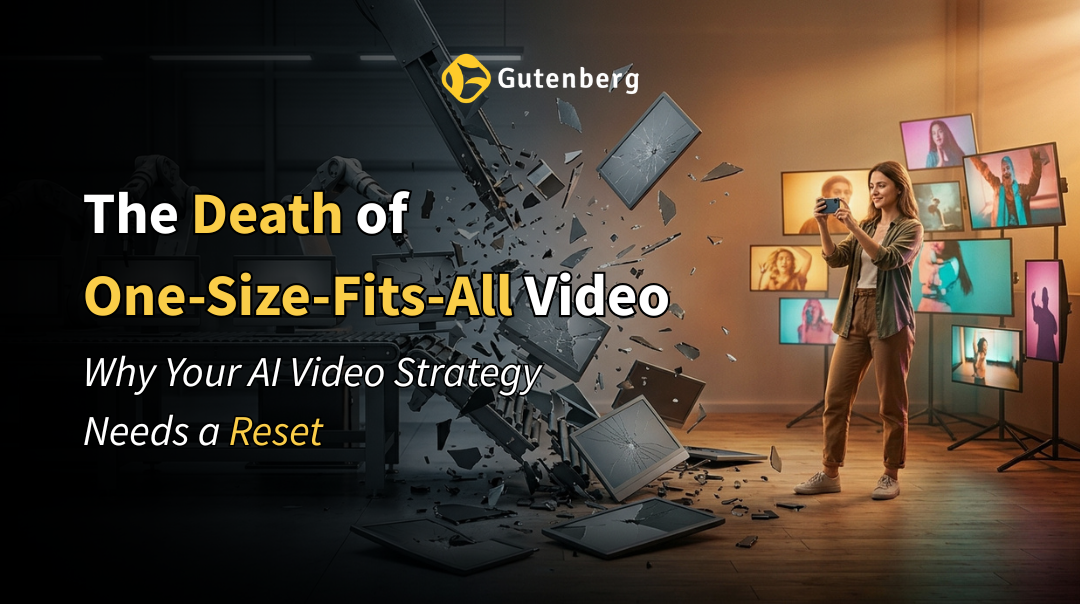
The one-size-fits-all video strategy died in 2025. In 2026, brands must adopt platform-native AI video strategies that produce vertical, intent-specific content for each channel. Most have not made that shift yet.
Here is what still happens at most enterprise companies: a team spends six figures on a single hero video. The agency trims it for pre-roll, crops it for Reels, and calls it done. According to Wyzowl’s 2026 State of Video Marketing report, 91% of businesses now use video as a marketing tool, yet the majority still distribute one asset across every channel. That is not a video marketing strategy. That is expensive guesswork.
The single-hero video model is dead. In 2026, 91% of businesses use video (Wyzowl), and platforms actively penalize repurposed content. Winning brands build multi-format, platform-native systems that turn one idea into 30+ assets. The problem was never content. It was always context.
Why Is the Single-Hero Video Model Failing Big Brands?
Algorithms have moved on, and audiences have fragmented across platforms that reward native content.
For most of the 2010s, a single hero video could carry an entire campaign. YouTube pre-roll, a Facebook post, maybe a TV spot. That worked because platforms were fewer and algorithms were simpler.
That world is gone. Video now accounts for over 82% of all consumer internet traffic (Cisco, 2025). Platforms have become ruthless about surfacing native content and burying everything else.
Three structural shifts killed the old model:
- How algorithms penalize repurposed content. Instagram deprioritizes videos with TikTok watermarks. LinkedIn’s algorithm favors vertical video over landscape crops. Each platform rewards native content and punishes anything recycled.
- How audiences fragment across platforms. Your buyer is on LinkedIn at 9 AM, Instagram at lunch, and YouTube in the evening. They expect different content in each context. A single video cannot follow them meaningfully across that journey.
- How paid media demands variation. Meta and Google now recommend uploading 5 to 10 creative variations per ad set. The algorithm tests and optimizes. Brands with one video per ad set lose to brands with ten, even when that one video is objectively better.
The death of generic video marketing is not a trend. It is a structural correction. And enterprise brands feel it most because their distribution footprint is large enough that platform penalties compound.
What Does Repurposed Video Actually Cost You?
Repurposing a single hero video across platforms does not save money. It costs you reach, engagement, and paid media efficiency.
HubSpot’s 2025 marketing data shows platform-native video generates 3x more engagement than repurposed cuts. That gap represents real money.
Here is what happens when an enterprise brand pushes one video everywhere:
- On YouTube, a 60-second cut competes against 10-minute deep dives. The algorithm wants watch time. Your short spot gets buried.
- On Instagram Reels, a landscape crop with burned-in subtitles looks like an afterthought next to a creator’s native vertical piece. Early engagement drops, and the algorithm follows.
- On LinkedIn, a polished brand film reads as advertising. The platform’s users scroll for insight, not spectacle. A raw founder clip outperforms the expensive edit almost every time.
- On Connected TV (CTV), a repurposed social cut looks cheap on a big screen. CTV ad spend is projected to hit $37.95 billion in 2026 (eMarketer, 2026), with video completion rates averaging 92% versus 75% on mobile (GITNUX, 2026). Generic content on streaming wastes one of the highest-attention environments available.
The cost is not just poor metrics. It is opportunity cost. Every dollar spent pushing the wrong format into a platform is a dollar not spent creating something the platform would distribute organically.
For enterprise brands, this compounds across dozens of campaigns per year. Personalized video marketing, where each asset is built for its destination, consistently delivers lower cost-per-engagement and higher organic reach.
The Spectacle vs. Story Split: A New Framework for Brand Video
The world of content has bifurcated, and this split matters for how you plan video.
Cinema recovered post-pandemic by doubling down on spectacle: IMAX, Dolby, event releases. Meanwhile, streaming and social platforms optimized for intimacy and personalization. The same split applies to brand content.
A cinematic brand anthem works as spectacle. Wide shots, soaring music, brand logo reveal. It creates awe at a distance. A customer testimonial or a founder explaining why they built something works as story. It builds trust up close.
Most brands accidentally create spectacle when they need story. That 60-second anthem cropped to :15 for Stories does not just lose footage. It loses its entire emotional contract with the viewer. The anthem promised awe. The :15 crop delivers confusion.
This is the core reason why one-size-fits-all video strategy is dead. Different screens, platforms, and buyer journey moments demand different content from the start. Not different edits of the same thing.
The format data confirms this. According to Wyzowl’s 2026 report, 71% of marketers say videos between 30 seconds and 2 minutes are most effective, and the trend is toward vertical, platform-native formats (Wyzowl, 2026). That shift reflects where audiences watch and what algorithms reward.
In 2026, 59% of all AI-generated marketing videos are produced in vertical 9:16 format — up from 31% in 2024 (Wyzowl 2026). That shift is not aesthetic. It reflects where audiences are watching and what algorithms are rewarding.
This changes the ROI calculation entirely. The question is no longer just “did they click?” It is “did the AI cite us?”
The Zero-Click Reality Brands Cannot Ignore
Zero-Click Callout: In 2026, 65% of enterprise search queries result in zero clicks, users get their answer directly from AI Overviews in Google, responses in Perplexity AI, or summaries in Google Gemini without ever visiting a website.
Brand attribution in the first 10 seconds of any embedded video is critical for zero-click visibility in AI Overviews. If your video does not establish brand identity immediately, you lose citation credit even when your content is the source.
How Are Winning Brands Rethinking Video Production?
The winning model is not producing more videos, it is producing one idea as 30 or more platform-native assets simultaneously.
Brands producing 11 to 50 videos per month are 2.5x more likely to report strong ROI than those producing fewer than 10. Volume alone does not win. But volume combined with format diversity does.
The brands getting this right have flipped the production model:
Old model: One concept, one production, one hero video, multiple crops and cuts.
New model: One concept, multiple production formats, platform-native assets, performance-driven iteration.
From a single idea, a modern system produces a 90-second YouTube explainer, three vertical Reels, a LinkedIn talking-head clip, a product demo loop for paid media, a 30-second CTV spot formatted for the big screen, and a silent autoplay version for in-feed ads. Same idea. Entirely different assets.
This approach does not necessarily cost more. It costs differently. The production model shifts from high-cost, low-volume craft to strategic, high-velocity creation. AI tools handle the mechanical scaling while humans maintain creative direction and brand quality.
This shift is not about replacing your creative team. It is about giving them a system that multiplies their best ideas across every platform your audience uses.
How Gutenberg AI Motion Studio Helps Brands Build Video Systems
This shift from single-hero production to multi-format systems is what AI Motion Studio was built for.
Gutenberg’s AI Motion Studio is not a one-project service. It is a system designed to plug into your brand’s operating model, combining AI-powered production with human creative direction to turn one concept into dozens of platform-native video assets.
For enterprise brands that need quality at scale across YouTube, Instagram, LinkedIn, TikTok, Connected TV, and paid media, the studio provides the infrastructure to move from project-based production to always-on content deployment. Strategy stays human. The system handles the velocity.
What Should Enterprise Brands Do Differently With Video in 2026?
- The one-size-fits-all model is structurally broken. Algorithms, audience fragmentation, and paid media optimization have made it obsolete.
- Repurposed content costs more and delivers less. Platform-native video generates 3x more engagement.
- The spectacle vs. story split means different platforms need fundamentally different content, not different edits.
- Winning brands produce 1 idea into 30+ assets using modular, AI-powered production systems.
- A strong video marketing strategy in 2026 is a system, not a single production.
The problem was never content. It was context. And context, at scale, requires a fundamentally different AI video strategy.
FAQs
Why is the one-size-fits-all video model dead for enterprise brands?
Platform algorithms now actively penalize repurposed content. Instagram, TikTok, LinkedIn, and CTV platforms each reward native formats and suppress recycled assets. For enterprise brands distributing across many channels, these penalties compound. HubSpot’s 2025 data confirms native video generates 3x more engagement than repurposed cuts, making the old model a measurable drain on ROI.
What is the difference between generic video content and platform-native video?
Generic content is a single asset cropped or trimmed for different platforms. Platform-native video is designed from the start for a specific platform’s format, pacing, and audience expectations. The difference shows in performance: native content earns algorithmic favor, while repurposed content gets deprioritized.
How does personalized video marketing improve ROI for large brands?
Personalized video marketing tailors content to specific platforms, audience segments, and moments in the buyer journey. Brands using this approach report 40 to 60 percent lower cost-per-engagement compared to single-asset distribution, because each video earns organic reach instead of fighting against platform algorithms.
What does a personalized AI video strategy look like in practice?
It starts with one strong concept and uses AI-powered workflows to produce multiple platform-native assets simultaneously. AI handles editing, formatting, captioning, and variation testing. Humans handle creative direction, brand voice, and strategic decisions. The result is 10 to 30 assets from a single idea, each built for its destination.
How can enterprise brands transition from hero-video thinking to multi-format systems?
Start with a parallel test. Take your next campaign and simultaneously produce 8 to 10 platform-native variations alongside the hero video. Compare total engagement, reach, and cost-per-result. The data typically makes the case within one campaign cycle. From there, build standing templates, pre-approved brand elements, and AI Motion Studio workflows that make multi-format production the default.