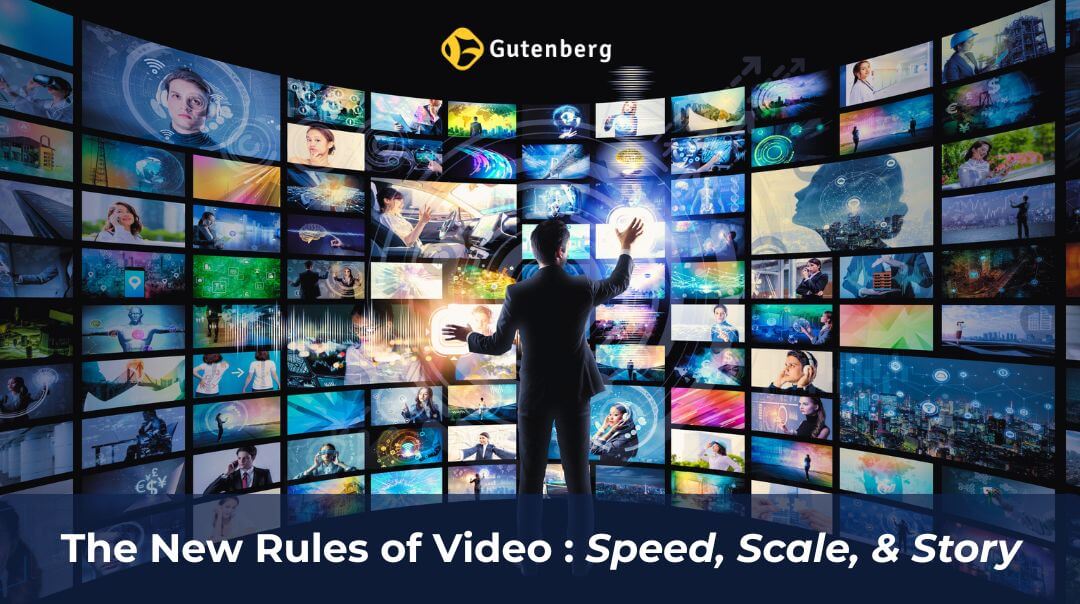
Here is something worth sitting with: top-performing brands often publish several times more video per week than the average brand in their category. And they are not spending several times the budget to do it. They have changed how video gets made.
The old rule was simple. Produce one great video per campaign. The new rule is harder to accept. Produce one strong idea, then turn it into a full set of assets built for every platform your audience actually uses. Video content strategy in 2026 is not about making one perfect film. It is about building a system that keeps up with how fast people move online.
Video adoption has hit a ceiling. 91% of businesses now use video, a joint all-time high (Wyzowl, 2026). Since almost everyone has video, the edge shifts from “are you making it” to “can you make enough of it, fast enough.” Winning brands turn one idea into 30-plus platform-native assets. Content is no longer produced. It is deployed.
Why Has Video Speed Become More Important Than Video Polish?
Video adoption has plateaued. It has already won the argument. Wyzowl’s 2026 State of Video Marketing report confirms 91% of businesses now use video as a marketing tool, a joint all-time high. When almost every brand makes video, having video is no longer an advantage. Making it fast enough, and often enough, is.
Three shifts made speed the deciding factor.
- Algorithms reward frequency. Instagram, TikTok, YouTube Shorts, and LinkedIn all favor accounts that post consistently. Skip a week and your reach drops. Skip a month and you start over.
- Audiences move across platforms all day. Your buyer might be on LinkedIn in the morning, Instagram at lunch, and YouTube at night. They expect something different in each place. One video cannot follow them through that.
- Paid ad platforms need variety to work well. Meta and Google commonly recommend uploading multiple creative variants per ad set, often somewhere in the range of five to ten. Their systems test each version and shift spend toward whatever performs best. A brand running one video per ad set is competing against brands running many, even when that one video looks better on its own.
Short-form video under 60 seconds now drives roughly 2.5 times more engagement per impression than longer formats, according to industry roundups. That is not a reason to make only short videos. It is a sign that speed and variety now beat a single polished production.
What Does “1 Idea Into 30 Assets” Actually Look Like?
The old production model went like this: campaign brief, script, shoot, edit, one hero video, then cut-downs for other platforms. The new model flips that order. One concept becomes many formats, built at the same time, each one designed for where it will live, not squeezed into it afterward.
Say the idea is a product launch for a new service. From a single shoot, a modular system can produce a partial set like this:
- A 90-second explainer for YouTube
- Several vertical clips for Reels and TikTok, each with a different hook
- A talking-head cut for LinkedIn
- A short product demo loop for paid ads
- A silent, autoplay-friendly version for in-feed placements
- Hook-first variants built specifically for A/B testing
- Caption-led cuts made for sound-off viewing
- Still frames and carousel frames pulled from the same footage
- A trimmed version built for email or landing-page embeds
Same story. Same core idea. A dozen or more distinct assets, each one built for its destination. Most competitive brands land somewhere between 10 and 30 assets from a single strong concept, depending on how many channels they actually run.
This does not have to cost more. It costs differently. AI tools now handle much of the repetitive work, including editing, captioning, resizing, and testing variations, while people stay in charge of the story and the brand voice. AI-assisted workflows have materially lowered the cost and time required per finished asset. That shift is what makes a multi-asset system realistic for a mid-size marketing team, not just a Fortune 100 one.
Why Doesn’t the Old Production Model Scale Anymore?
Brands running active, multi-channel programs often need a high volume of video assets per quarter to stay visible across paid, owned, and earned channels. Traditional production, the kind that runs four to eight weeks from brief to delivery, was built for a much smaller number.
Three reasons this breaks down:
- Everything happens in order. Brief, script, shoot, edit, review, revise, deliver. Each step waits on the one before it. That works fine for one video a month. It falls apart at high volume.
- Every video gets treated like the main event. That level of care makes sense for a big campaign film. It becomes a bottleneck when you need fifteen social clips by Friday.
- Cost per project. A 60-second video costs a set amount. Need twenty variations? That is roughly twenty times the cost, even though most of the creative decisions happened once, at the start.
The fix is not doing the old process faster. It is replacing it with one designed for speed from day one.
What Role Should AI Actually Play?
Sixty-three percent of video marketers now use AI tools to help create or edit marketing video, up from 51% the year before. That number keeps climbing because AI removes the parts of production that used to eat the most time.
Here is where AI genuinely helps:
Faster editing. Automatic rough cuts, scene detection, and format resizing turn one shoot into several finished assets in hours instead of days.
Personalization at scale. Text overlays, localized voiceovers, and small variations for different audiences become affordable instead of cost-prohibitive.
Smarter distribution. AI can help predict which hooks, thumbnails, and video lengths are likely to work best on each platform, so less time gets wasted guessing.
Here is where AI should stay out of the way: the idea itself. The story, the brand voice, and the strategic point of the video still need a person behind them. AI multiplies a good idea. It cannot replace one. Brands that try to skip the idea and let AI generate the concept usually end up with content that looks fine and says nothing.
How Gutenberg’s AI Motion Studio Supports Content Velocity
Building a system that turns one idea into dozens of platform-ready videos is exactly the problem AI Motion Studio was built to solve.
Rather than treating every video as a one-off project, AI Motion Studio combines AI-powered production with human creative direction, so a single concept can become a full set of platform-native assets without running a full production cycle for each one. Explainers, vertical cuts, sound-off versions, ad variants, and still frames come out of the same modular workflow, built in parallel instead of one at a time.
For brands managing video across YouTube, LinkedIn, Instagram, TikTok, and paid channels at once, that means strategy stays human while output keeps pace with how fast content actually needs to move. For in-house teams and marketing organizations that need real velocity without building out a large production headcount, it shortens the distance between an approved idea and a deployable asset set, so more of the budget goes toward getting the story right and less toward re-doing the same work five different ways.
Frequently Asked Questions
How many video assets does a brand need per campaign now?
Most competitive brands produce somewhere between 10 and 30 platform-specific assets from a single core idea. This includes different lengths, aspect ratios, and platform-native versions rather than one video cropped multiple ways. The exact number depends on how many channels the brand is actively using, and how well each asset actually fits its platform matters more than hitting a specific count.
Why do short videos get more engagement than long ones?
Short-form video under 60 seconds generates roughly 2.5 times more engagement per impression than longer formats, largely because attention spans on mobile and social platforms favor quick, easy-to-finish content. Longer videos still win in other situations, especially detailed explainers, product walkthroughs, and anything meant to move someone through consideration rather than just catch their attention.
Does using AI in video production hurt quality or authenticity?
Not when it is used correctly. AI works well for editing, resizing, captioning, and testing variations, tasks that are mechanical rather than creative. Quality problems usually show up when a brand tries to use AI to invent the core idea instead of just executing it faster.
What is the difference between content velocity and just posting more often?
Content velocity means producing more relevant, platform-native assets from a single strong idea, not just increasing the number of posts. Posting more low-quality or repurposed content without a real system behind it usually hurts performance instead of helping it.
How long does it take to build a modular video production system?
Most brands can move from single-asset production to a basic modular system within a single quarter, often starting with one campaign as a pilot before rolling it out further. AI tooling for editing and format conversion is what makes this timeline realistic, since it removes most of the manual work that used to slow the transition down.