AI visibility isn’t SEO 2.0. Getting your brand cited by ChatGPT, Perplexity, and Google’s AI Overviews takes three disciplines firing on the same query at once, and no single team can deliver it alone.
Getting cited inside AI answers isn’t a content tweak or an SEO patch. Generative engines build answers from a whole corpus — your site, its structure, and what the rest of the web says about you. So AI visibility is won at the intersection of three disciplines: Digital (the machine-readable foundation), Content (the citable substance), and PR (the third-party authority). Run them in silos, and you stay invisible.
Most brands are approaching AI search with the wrong diagnosis. They treat being cited by ChatGPT, Perplexity, and Google’s AI Overviews as “SEO 2.0”, a technical exercise you hand to a specialist, tick off, and move on. It’s an understandable instinct. It’s also why so many well-optimised sites are missing from the answers their buyers actually read.
The audience is already changing its behaviour. G2’s 2026 research, based on more than 1,000 B2B software buyers and decision-makers, found that 71% now rely on AI chatbots somewhere in the software research process, while 51% start their research with an AI chatbot more often than Google.
That changes the question marketers need to ask.
It is no longer simply:
“How do we rank?”
It is:
“When our audience asks the question, are we part of the answer?”
Generative engines don’t simply return a ranked list. They retrieve information, synthesise it and construct an answer from multiple sources. The original GEO research describes generative engines precisely this way: systems that gather and synthesise information from multiple sources before producing a response.
So AI visibility ultimately comes down to three questions:
- Can the machine find and understand you?
- Is what it finds worth citing?
- Does the wider web provide enough evidence to support your authority?
Those are Digital, Content and PR questions respectively.
Content: The Citable Substance
Content is where AI visibility was first proven to be engineerable, and the evidence is unusually rigorous. The foundational academic research — “GEO: Generative Engine Optimization” by Aggarwal et al., presented at KDD 2024 by researchers from Princeton, Georgia Tech, the Allen Institute for AI, and IIT Delhi, tested nine optimisation tactics across roughly 10,000 queries and nine domains. Its headline finding: the right content moves can lift visibility in generative responses by up to 40%.
Crucially, the techniques that worked were all about substance, not tricks. Adding credible statistics, incorporating quotations from relevant sources, and citing reputable sources within your own content produced the biggest gains: a 30–40% relative improvement in the study’s core visibility metric. Fluency and clarity of writing added a further 15–30%, because well-constructed prose is simply easier for a model to parse and attribute.
Just as important is what failed. Keyword stuffing, content padding, and pure persuasive language did nothing or actively hurt visibility. The old growth-hacking reflexes don’t just underperform here; they backfire. And the study’s most overlooked finding is what strategists call the equalizer effect: lower-ranked pages benefit far more than top-ranked ones, with citation-rich content lifting a position-five page’s visibility by over 115%. Authority, in the AI era, is partly earnable through better content.
But notice the ceiling built into all of this. Every winning content tactic- statistics, citations, quotes, clarity- is a signal the model still has to be able to reach and parse. Which is where Content hits its limit and hands off.
Digital: The Machine-Readable Foundation
Content only earns a citation if the machine can crawl it, render it, understand its structure, and trust its freshness, and that’s Digital’s territory. The link between the two disciplines is now measurable. Roughly 87% of ChatGPT’s citations overlap with Bing’s top-10 results, and the vast majority of Google AI Overview citations map to pages already ranking on Google. As SERP’s Jeremy Moser puts it, “80% of GEO is good, fundamental SEO.” The technical substrate hasn’t stopped mattering; it’s become the price of entry.
Structure does specific, quantifiable work. Around 68.7% of ChatGPT citations come from content that follows a logical heading hierarchy and 44.2% of all LLM citations are drawn from the first 30% of a page — front-loaded answers, clean heading nesting, schema markup, and fast, renderable pages are what let a model extract cleanly.
Freshness compounds it: content updated within 30 days carries a 3.2x citation multiplier, and around 65% of AI-crawler hits target content less than a year old.
This is real, skilled, ongoing work: crawlability, structured data, Core Web Vitals, AI-bot access, publish-and-update cadence. But it’s a foundation, not a finish line. A perfectly optimised, perfectly structured page can still lose the citation to a rival the model simply trusts more. That trust is built somewhere your Digital team can’t reach.
PR: The External Validation Layer
Here’s the part most AI-visibility playbooks quietly skip, and it’s the one that breaks the “it’s just SEO” framing entirely. Generative engines weigh what other credible sources say about you at least as heavily as what you say about yourself. Analyses of the founding research and its successors consistently find that AI engines favour earned media, authoritative third-party coverage, over brand-owned content when deciding whom to name.
This is PR’s home turf, recast for the machine age. Earned media, expert commentary, analyst mentions, and thought leadership are precisely the signals that let a model distinguish a brand that merely publishes content from one the wider web recognises as an authority. Being mentioned isn’t even sufficient on its own; what raises citation odds is corroboration across multiple independent, reputable sources. A model reaching for an answer is looking for consensus, and consensus is manufactured, legitimately, through relationships and reputation, not through a CMS.
Muck Rack’s 2026 analysis examined more than 25 million links from ChatGPT, Claude and Gemini across 17 industries and found that earned media accounted for 84% of AI citations.
Put plainly: your own site can claim expertise all day. Only third parties can corroborate it. And corroboration is exactly what a generative engine is scanning for before it puts your name in an answer it’s willing to stand behind.
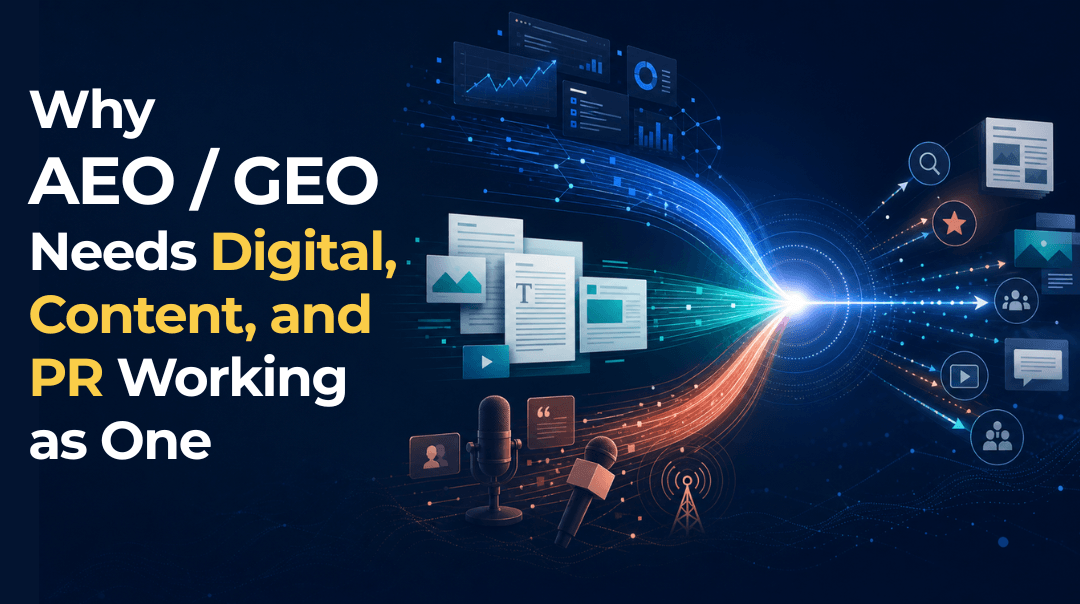
Digital makes you retrievable. Content makes you quotable. PR makes you trusted.
Why No Single Discipline Wins
Line the three failure modes up, and the argument makes itself. A brilliant PR programme with a broken, unstructured site: the model hears you’re an authority but can’t cleanly retrieve you. Flawless technical SEO with thin, unsourced content: crawlable, parseable, and not worth quoting. Rich, statistic-laden content on a fast site with zero earned coverage: quotable, but unvalidated, so the model reaches for the competitor the web actually vouches for.
Each discipline covers exactly the blind spot the other two can’t see. Digital makes you retrievable. Content makes you quotable. PR makes you trusted. AI visibility is the rare marketing outcome that requires all three signals to fire on the same query at the same time, which is precisely why it falls through the cracks in organisations where SEO, editorial, and communications report to different leaders, chase different metrics, and rarely share a brief.
The implication for how most marketing functions are structured is uncomfortable: AEO/GEO can’t be assigned. It has to be orchestrated. The brands winning citations aren’t the ones who hired a “GEO specialist.” They’re the ones who got their technical, editorial, and earned-media teams working from a single visibility strategy, treating a target query as a shared objective rather than three separate tickets.
What an Integrated AEO/GEO Program Looks Like
In practice, orchestration means one strategy with three synchronised workstreams.
Digital establishes the retrievable foundation: structured data, clean hierarchy, crawler access, and a freshness cadence. Content produces the citable substance the research rewards: statistic-dense, well-sourced, clearly written passages built to be extracted, not just read. PR earns the third-party corroboration that turns a quotable page into a trusted one, seeding authoritative mentions across the sources models actually weight.
“AEO/GEO can’t be assigned. It has to be orchestrated.”
The connective tissue is shared measurement. Because none of the three teams can see the whole picture alone, an integrated program tracks a common set of AI-visibility metrics: citation frequency, share of model against competitors, and citation sentiment across ChatGPT, Perplexity, Gemini, and AI Overviews, so every discipline is optimising toward the same answer, on the same query, at the same time. That shared scoreboard is what turns three departments into one system.
That’s the real reposition AI search demands. Not a new specialist bolted onto an old org chart, but a genuinely cross-disciplinary team pointed at a single outcome: being the brand the machine chooses to name.
Frequently Asked Questions
Is AEO/GEO just the new SEO?
No. SEO earns a ranked link; AEO/GEO earns a citation inside a synthesised answer.
Traditional SEO is the technical foundation; around 80% of GEO rests on it, but AI visibility adds two demands SEO alone doesn’t cover: content built to be quoted, and third-party authority that models can corroborate.
Can one specialist handle our AI visibility?
Rarely well. The signals that earn citations span three disciplines: technical crawlability, citable content, and earned authority, which usually sit under different teams. A single specialist can coordinate, but the actual work has to be executed across Digital, Content, and PR against one shared strategy.
Which matters most: Content, Digital, or PR?
None dominates; they’re sequential dependencies. Digital makes you retrievable, Content makes you quotable, and PR makes you trusted. A weakness in any one caps the other two — a great page on a broken site, or brilliant content with no third-party validation, both lose the citation.
How is AEO/GEO success measured?
Not by rankings. The core metrics are citation frequency (how often you appear in AI answers), share of model (your mentions versus competitors), and citation sentiment (whether the answer represents you accurately), tracked across ChatGPT, Perplexity, Gemini, Copilot, and Google’s AI Overviews.